
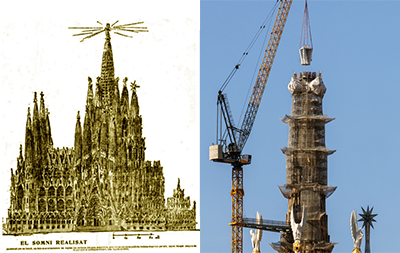
The first glimpse of what the Sagrada Familia in Barcelona would become upon completion was the drawing published under the title “El somni realisat” (“The Dream Realized”) on January 20, 1906, in the newspaper La Veu de Catalunya, illustrating a page dedicated to the temple under construction with articles by various authors. This magnificent image effectively represented what at the time, and for decades afterward, was considered an impossible dream by some and untimely by others, though firmly rooted in the unwavering will of the great architect and those who succeeded him.
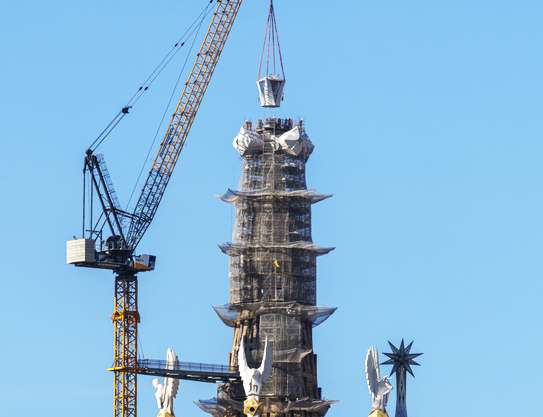
On February 20th, the placement of the final piece of the tower of Jesus Christ signified much more than the end of a construction phase with its traditional flag-raising ceremony. It represented the realization of a dream that survived all kinds of setbacks: when it wasn’t financial constraints, it had to contend with attacks from purists of style and ideology, and even with looting and arson.
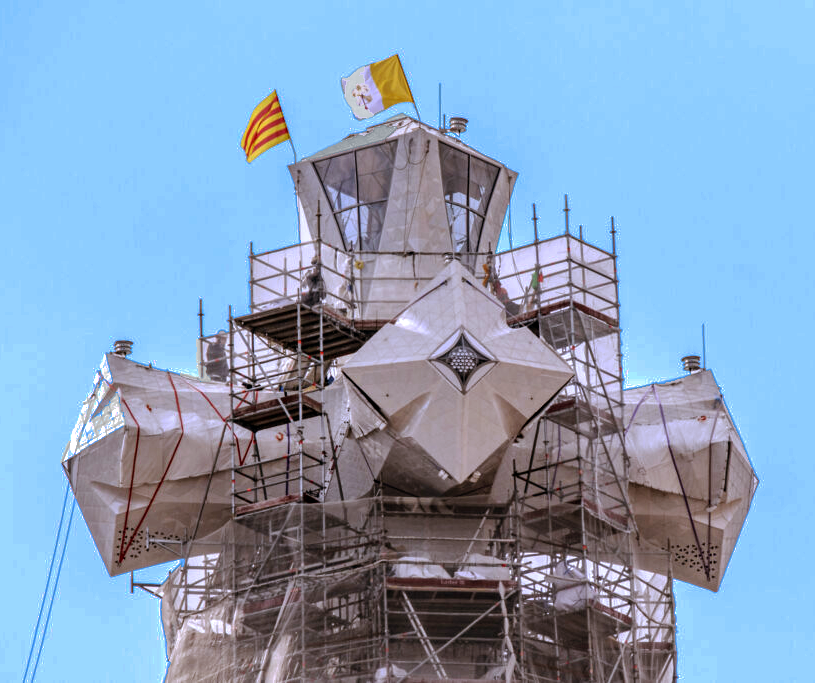
Images of the placement of the last piece of the 4-armed cross that crowns the tower of Jesus Christ (https://sagradafamilia.org)
In 1883, Gaudí began work on the project of his predecessor, Francisco de Paula del Villar, with some modifications. Progress was very slow during those early years, as funding fell short of expectations, until a significant donation arrived in the early 1890s. By then, the architect had also matured his ideas, and this new situation allowed him to unleash his creativity, conceiving a much more ambitious building, which he himself described as a transcendence of Gothic architecture.
This project continued to evolve throughout Gaudí’s lifetime. A detailed account would exceed the scope of this article. In his later years, aware that he would not finish the work, the architect dedicated his efforts to producing the entire project in a rigorous geometric language based primarily on ruled, warped surfaces, which he materialized in plaster models. The regrettable fire and destruction of the workshop in 1936 was one of the hardest blows to the continuity of this dream, but it did not stop it thanks to the unwavering perseverance of those who were in charge of the work at that time.
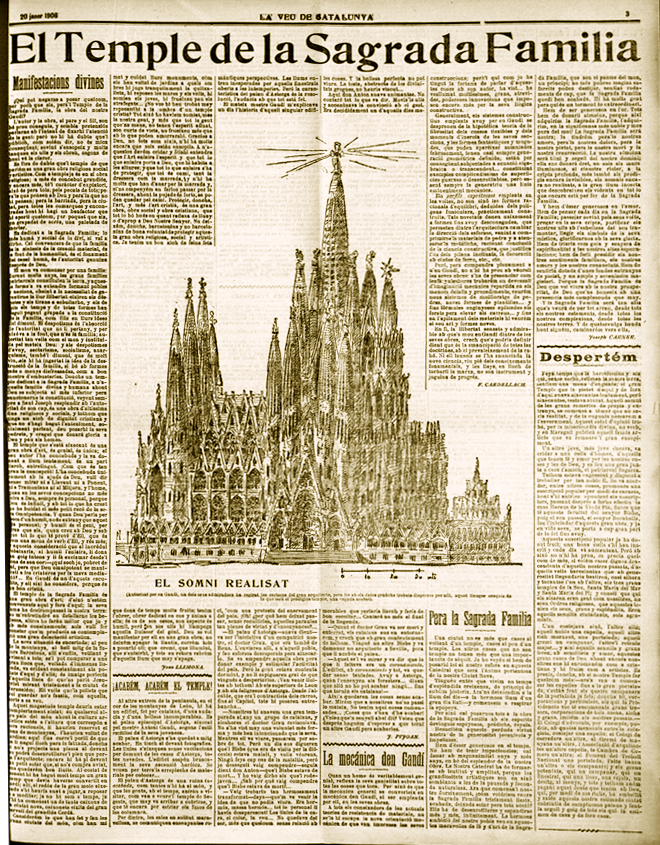
The publication of the first drawing of the Sagrada Familia as it would appear once completed. La Veu de Catalunya, January 20, 1906
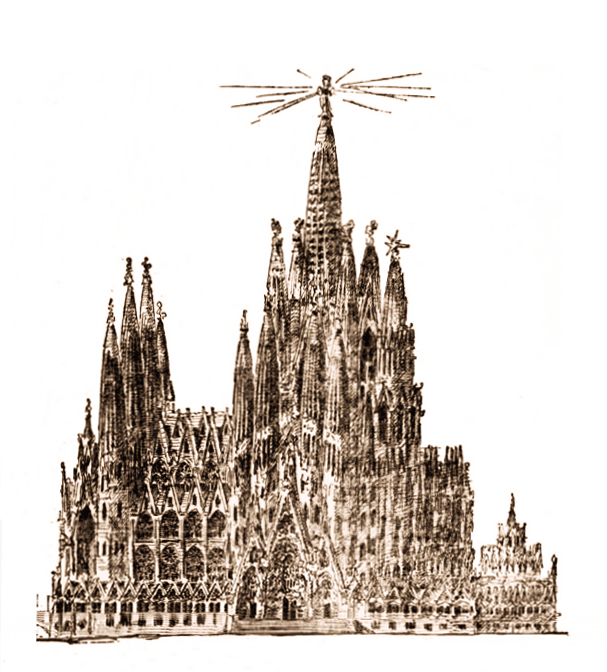
The construction of the Sagrada Familia has been the subject of both praise and criticism throughout its history. From technical, ideological, and artistic perspectives, it has been both lauded and criticized. Gaudí’s growing worldwide fame and the resulting influx of visitors have enabled the sustained progress of the works in recent decades, culminating in the realization of that dream contained in a drawing from 120 years ago, with only the Glory façade remaining to be completed.
The Sagrada Familia is a remarkable example of architectural experimentation, where Gaudí and his successors applied cutting-edge design and construction techniques and methods. Despite the debate about the ornamentation and the contributions of certain artists, it can be said that the spirit of the Sagrada Familia that Gaudí envisioned has not been betrayed.
The completion of the magnificent cross that now watches over us from its 172.5 meters of height makes it the tallest church in the world, and is the milestone that makes Gaudí’s dream a reality.