
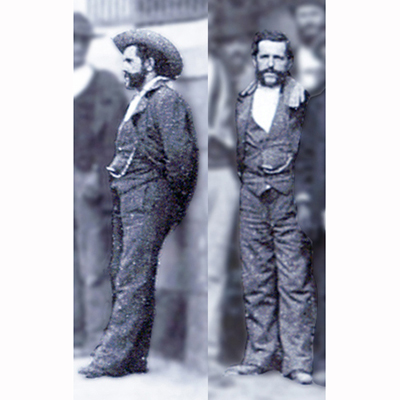
Given the small number of existing images of the architect Gaudí, it is interesting to see some photographs taken during his work for the visits of King Alfonso XII, his family and his court to Comillas, Santander, in the summers of 1881 and 1882.
The photos were taken by Leandro Desages for an album made in order to record those remarkable days. In several of the photographs posed the architects, technicians and workers sent to Comillas at the request of the host, Antonio López, who worked on the various constructions assembled for the events, some of them ephemeral, to turn HIS native town into a setting worthy of such an important event.
Antonio López, owner among others of the Transatlantic Company, which for decades had the concession of mail between Spain and the American colonies, as well as lines to the Philippines and African countries, had set out to add value and prestige to his native town of Comillas, until then a small town on the Cantabrian coast, to turn it into the summer resort of the wealthy classes of Spain. and also in a first-class study center. To this end, he commissioned Joan Martorell, an architect from Barcelona with whom Gaudí collaborated in those years, to build the building of the Major Seminary, and the palace for residence and the chapel-pantheon of his family.
The project of the furniture for this chapel was delegated by Martorell to his young collaborator, who was also commissioned to design the magnificent kiosk for the rest and enjoyment of the royal couple and their family, located in the gardens of the Casa de Ocejo. It was a remarkable construction of iron, wood, glass and fabrics, one of its particularities was the profusion of glass bells and metal spheres that rang when swayed by the sea breeze.
To guarantee the realization in time of the enormous undertaking, López sent some three hundred architects, artists and craftsmen from Barcelona and Santander, under the orders of the Catalans Oriol Mestres and Cristóbal Cascante. The latter, a classmate and friend of Gaudí, was also a collaborator of Joan Martorell, who was summoned to participate in the tasks too.
Desages recorded the royal visit of 1881 in an album with 26 photographs, today deposited in the Royal Palace Library and forming part of the Spanish National Heritage. In two of the photographs it is possible to observe a character who bears a strong resemblance to the great Antonio Gaudí, so it is plausible to conjecture that it would indeed be himself, given that it is documented that he was part of that group of artists.
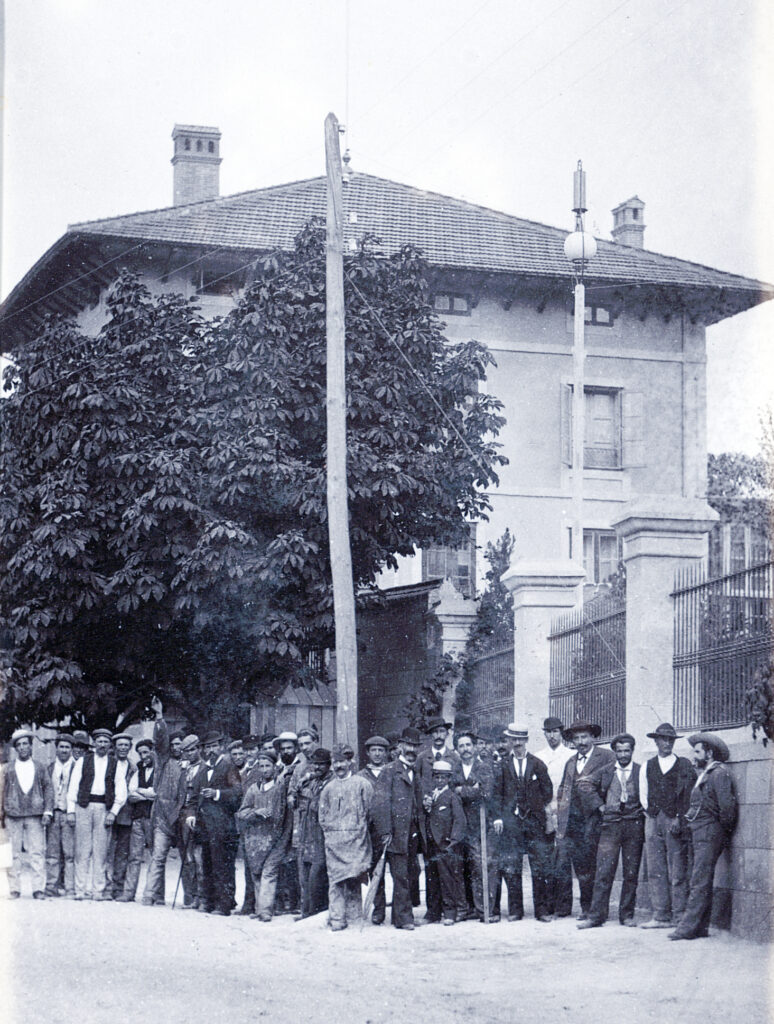
Group of people posing in front of the Casa de Ocejo. The first on the right and placed in profile without looking at the camera is very possibly Gaudí. Image 10191572. Real Biblioteca de Palacio, Madrid, Patrimonio Nacional, FOT/365
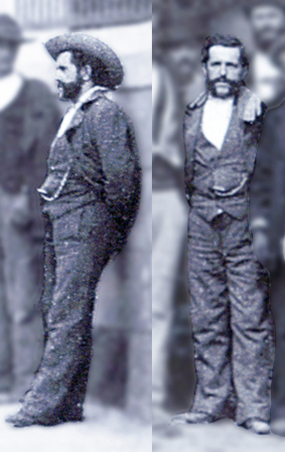
We will first analyze the photograph registered with the number 10191572 in the National Heritage Catalog: We see there portrayed a group of 28 people posing in front of the Casa de Ocejo. The various costumes suggest that among them were the architects and artists posing together with the workers. The character seen on the far right is surely our great architect. His physical build and features leave little room for doubt.
We observe Gaudí dressed in a suit with a waistcoat, from one of its pockets hangs the chain of a watch, and covering his head with a large hat that protects him from the rays of the Cantabrian summer sun. He is seen in profile and without looking at the camera, as he would do two years later in another group photo, the well-known image taken in the cloister of the Cathedral of Elna (France) by the group of the Catalanist Association of Scientific Excursions.
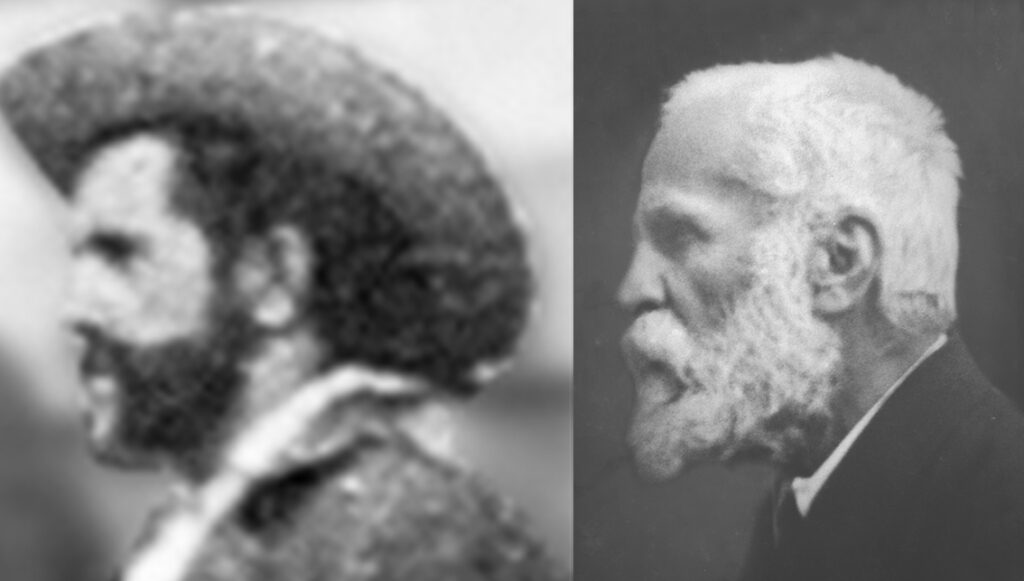
A comparison between the profile of the face of the character in the photo and that of Gaudí in the very famous photograph of the 1924 Corpus Christi procession in Barcelona (reflected) seems to dispel any doubts about his identity.
The second photo is the one cataloged with the number 10191573. It shows a group of approximately 38 men posing under an arch that according to descriptions was near the house of Antonio López. Here we see the same character from the previous photo, this time facing frontward and in the center of the scene. Once again, the figure and features of Gaudí are clearly recognizable. He wears the same clothes, but in this case without the hat. He shows the curious detail of his beard with a shaved chin.
Although he is seen uncomfortable in that central position, he denotes camaraderie with his teammates, who put their arms on his shoulders. To his left is the same person who in the previous photo is next to him, dressed in a suit and vest and wearing a small hat, who could be his friend and companion Cristóbal Cascante, judging by certain features compared to the only image we know of him. This attitude of confidence and complicity with his colleagues and workers coincides with the reviews of Gaudí’s personality, a man of affable treatment, cordial with his collaborators and fond of good conversation and simple humour.
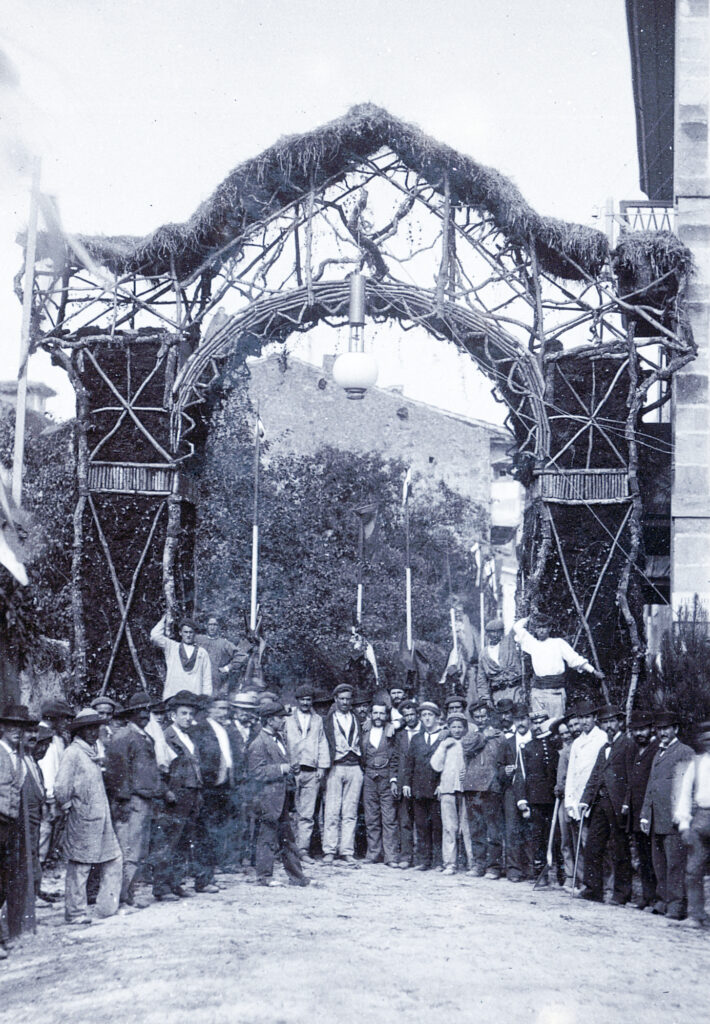
Group under the arch built with branches, shrubs and seeds near Antonio López’s house. Gaudí can be seen facing forward and in the center of the scene. Image 10191573. Real Biblioteca de Palacio, Madrid, Patrimonio Nacional, FOT/365
In a third photograph in the album, about fifty people can be seen under another construction that according to testimonies would have been projected by Cascante, formed by corn cobs and “tortas de borona” -traditional cornbread from northern Spain-, composing a proportionate semicircular arch with large buttresses. Although the photo is somewhat blurry, it allows us to infer that who seems to be the same person we have identified as Gaudí, and the one who has been assumed to be Cristóbal Cascante, are once again located at the center of the scene.
In conclusion, and based on all that has been explained, it can be assured with a high degree of certainty that the person indicated in the two photographs analysed is Antonio Gaudí, during his participation in the project and execution of the works on the occasion of the visit of King Alfonso XII and his court to Comillas in that summer of 1881.
This article is a summary of those published in the magazine Trépanos, no. 22, Year 7, Jun-Sep 2026 https://trepanos.es/2026/05/28/dos-posibles-fotos/ and in https://www.academia.edu/173627440/DOS_POSIBLES_FOTOS_DE_GAUDÍ